
How Can Participating in a Clinical Trial Help Me? (A Focus on CIDP)
Research & Clinical Trials
Read on to learn more about the basics of clinical research & why it is important to participate. Alternatively, click here to learn more about the ongoing clinical trials currently recruiting participants.
The Research Process: Bench to Bedside
The practice of medicine and treating patients involves a great deal of work “behind the scenes”. Many doctors, biologists, chemists, pharmacists, and other researchers dedicate their ideas, knowledge, and expertise to study potential new treatment options to treat, and possibly cure, medical conditions. This usually takes years, sometimes decades, and plenty of funding. Before a potential new treatment moves into the clinical trial phase, where it is given to human patients, the safety profile of the potential new treatment is studied extensively in the lab and often tested in animal models. This way, patients that take part in clinical trials can be assured that only the best, and most safe, potential new treatments make it to the clinical trial phase.
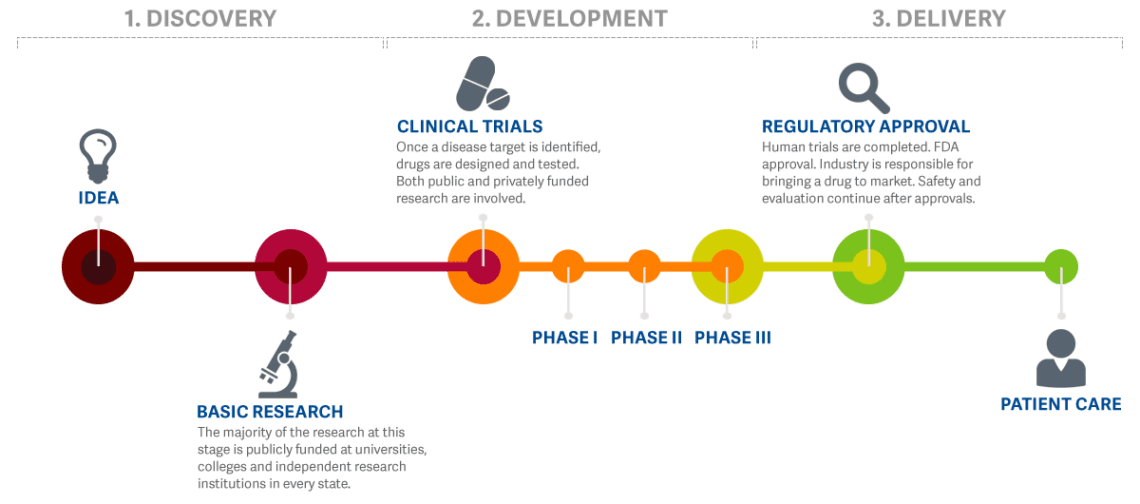
Before Clinical Trials in humans can start, investigators must submit all the data generated in the laboratory and in animals, for review by the scientists at FDA, to see whether there is any indication that this treatment might potentially be harmful. Investigators must also share some manufacturing details and characterization of the new chemical entity proposed to be tested in humans. The FDA must either request additional information from the investigator within 30 days or allow the clinical trials to begin.
Clinical Trial FAQs
Topics
If you are interested in a clinical trial, you should always first discuss this decision with your doctor; there is a chance your current doctor is part of the clinical trial team. If they are not, they will still be your doctor and will be in charge of overseeing your care. However, you will likely have to visit a doctor who is part of the clinical trial team in addition to your regular doctor.
Every clinical trial will have different requirements, but most clinical trials include a schedule of regular visits with doctors and nurses on the study team within a relatively short time-frame.
- Site: The hospital or medical center where a clinical trial is taking place. Clinical trials often have many sites across a country or many countries.
- Investigator: The doctor leading the clinical trial team at a particular site.
- Sponsor: The entity – possibly a drug-maker or government agency – that is responsible for creating and overseeing the clinical trial.
- Investigational drug / experimental drug / investigational product: The potential product, not yet approved for marketing for a specific disease, that is being tested in a clinical trial. It can be a drug, a blood or plasma product, a medical device, or a medical procedure/technique.
- Placebo – A placebo is sometimes referred to as a “sugar pill”, but can be any number of treatments that are not the potential new treatment being studied. In order to test the effectiveness of a drug, researchers need to determine the effectiveness of a potential new treatment, researchers compare the disease course and symptoms when the potential new treatment is taken vs. when it is not. When someone is not taking the potential new treatment during the clinical trial, they are taking the placebo.
- Placebo vs. control: Placebo does not always mean “sugar pill” or “no treatment given”. Sometimes, clinical trials test new potential treatments against what is the current standard of care. If someone is not getting the potential new treatment, they are acting as the “Control” in the clinical trial. In some innovative trials, people act as their own control, meaning they go through a period in the trial where they take the potential new treatment and compare their symptoms to a period when the person did not take the potential new treatment.
- Blinded: During a clinical trial, results are more valid if researchers are able to compare how symptoms change in patients taking the potential new treatment against those who do not when the researchers do not know who is receiving which treatment. This helps to eliminate bias (everybody wants new treatments to work!). People that might be blinded in a clinical trial include the investigator (doctor), the clinical trial team, the patient, the researchers doing the data, and the study sponsors.
- How will the study team communicate with my regular doctor?
- Will the study sponsor cover any expenses not covered by insurance? Is there an opportunity to be reimbursed for traveling to participate in the trial?
- What is the plan for care or receiving the drug when the trial is over?
- When will I know whether I received the potential new treatment being studied in the trial?
[Answer given by Dr. Sami Khella, Professor and Chair of Neurology, Penn Presbyterian] When a new medicine is tested in a clinical trial, frequently, a patient participating in the trial will be asked to stop her or his current medicine usually for a short period of time. This is called “a wash out period” or “a run-in period.” As the name wash out implies, it is done for 2 reasons:
- To clear the medicine itself from your body, and to clear its most recent effects on your body. This gives the new medicine a chance to work without confusion from the effects of the old medicine.
- To avoid a drug-drug interaction between the old and new medicines.
Remember that participants in clinical trials are monitored very closely and the health and safety of all participants is the top priority of any clinical trial.
Chronic inflammatory demyelinating polyneuropathy (CIDP) is a rare disease where the
body’s natural defenses, like antibodies, attack the covering of the nerves, called myelin,
and damage nerve function. While symptoms aren’t the same for everyone, CIDP can
make your arms and legs feel weak and slow your movements. The purpose of the ARISE
Study is to evaluate the safety and efficacy of an investigational medication in adults with
active CIDP.
Eligible patients will be:
- Adults aged 18 years or older
- Diagnosed with active CIDP
- Either:
- Willing to discontinue current treatment of intravenous immunoglobulin (IVIg) or subcutaneous immunoglobulin (SCIg) and/or corticosteroids prior to study entry OR
- Newly diagnosed with CIDP and have never been treated, or you have not taken medication for CIDP for at least 3 months prior to study entry
What can I expect if I join the study?
- You will receive a thorough medical exam and your CIDP diagnosis will be confirmed.
- If you qualify and are currently receiving treatment for CIDP, you will be asked to discontinue or taper off this treatment.
- You will receive study-required medical care throughout the study by a neuromuscular neurologist.
- All who qualify will receive the investigational medication for a portion of the study. The investigational medication will be an IV infusion.
- If you qualify for another portion of the study, you will be randomly assigned to receive either the investigational medication or a placebo that has no active drug. You will not know which treatment you will receive.
- If you qualify for all portions of the study and wish to continue, you can expect to spend up to 2–5 years in the study.
Participants will receive study-required medical care at no cost. Participants who qualify to receive the investigational medication will receive it at no cost. The study will not pay for other medical care or current medication(s) needed to support your daily health care routine.
Visit https://globaltrialfinder.janssen.com/trial/CR109195 and https://clinicaltrials.gov/ct2/show/NCT05327114 to learn more about this clinical study.
GBS|CIDP Specific FAQs
Topics
While it is likely that our Centers of Excellence participate in cutting-edge research, these centers are not exclusive to GBS|CIDP research. Therefore, clinical trials may also be taking place at other hospitals/doctor’s offices, so please talk to your doctor and the clinical trial team to learn more.
Ongoing Clinical Trials
Explore current research, clinical trials, and scientific breakthroughs advancing the understanding and treatment of GBS, CIDP, MMN, and related conditions.